
BEYOND VISABILITY. BUILDING LASTING FANDOM FOR WOMENS CRICKET.
By Lisa Parfitt
🔗 Read the original article on creativebrief here.
The ICC Women’s T20 World Cup 2026 is set to ignite women’s cricket’s next era. For women’s sport the challenge isn’t just visibility, it’s making people care, and making that care stick.
A decade of empowerment
Twenty years ago women’s cricket in England was a niche pursuit, 10 years ago England Women’s matches drew average crowds of just 1,500 but with a clear ambition the women’s game transitioned into the professional era in 2014 when the England and Wales Cricket Board (ECB) awarded the first 18 professional contracts to England women’s players to be followed by a newly professionalised domestic framework in 2025 with 135 contracted domestic players.
In parallel the narrative for how women’s sport is perceived and is promoted has evolved. From proving women belong, challenging gender stereotypes, proving the legitimacy and quality with an implicit framing against men’s sport, to demanding parity and proving that women are worth more. These phases of empowerment have invariably informed the marketing and positioning of women’s sport to the public. The marketing must now move on to a new era - one where women have nothing to prove, where the sport owns its space not because it’s for women but because it’s elite professional sport.
The audience growth is real, but women’s sport is stuck in a cycle of moments. Data from the Women’s Sport Trust shows that global events drive attendance, viewership and social growth, but the question the ECB asked itself, ‘is this converting into long-term fandom?’ Apparently not. In answering their own question, the ECB’s audience strategy team uncovered that a stubborn “care gap” persists – cricket fans care 26% less about women’s cricket than men’s, a root cause hindering longer-term growth. This gap is not unique to cricket and exists in all major sports between the men and women’s teams, but reveals the need to convert fleeting moments of visibility into habitual fandom to ensure the game thrives in the long-term.
Next summer, England and Wales will host the ICC Women’s T20 World Cup - 33 matches across seven iconic venues, culminating at Lord’s. The stage is set for a transformative moment for the sport globally. Beth Barrett-Wild, Tournament Director and ECB Women's Professional Game Director clearly and passionately articulated the ambition for the tournament at the launch at Lord’s last April, “to break women's cricket into the mainstream and ensure it stays there.” The ECB has set its stall out, this isn’t just a moment in time, the tournament needs to win in the long-term - turning casual interest into generational passion, moving beyond purpose-driven messaging to selling the sport itself to capture the public’s imagination- the jeopardy, skill, and spectacle - to everyone who loves sport, so they keep coming back.
Behaviour change
If we want people to care about women’s cricket, we need to show them why it’s worth it. To drive lasting engagement with women’s cricket, the value of the tournament needs to be tangible and emotional - an unmissable spectacle of high-stakes competition, elite performance and tribal energy, where attending feels like a badge of honour.
Social proof and mainstream levers should reinforce that women’s cricket is the norm, with sellouts, trending moments and fan stories showing that everyone is going and everyone is talking about it. Bold moments, borrowing equity by plugging women’s cricket into pre-existing sources of status or emotion and culture-first collaborations.
Loss aversion will sharpen this momentum by using credible FOMO, underpinned by real scarcity, countdowns that make missing out feel consequential. Missed the Lioness Euros win, missed the Red Roses at Twickenham, then don’t miss out of Lord’s this summer!
Central to the ECB’s strategy is the players. As well as highlighting the stars of the game – Nat Sciver-Bunt, Harmanpreet Kaur, Ellyse Perry - for existing fans, it’s vital to build the profile of the players further. Fans of women’s sport want to know who the stars are a proven driver meaningful interest, connection and repeat attendance.
The strategy in action
Every women’s sport property is at a different phase of maturity. Having opted for a strategy of parity and alignment with the men’s game, cricket’s attendance and viewership in the UK has been steadily increasing. 1.5 million fans attended the women’s competition of The Hundred, over 120k fans attended a home Ashes in 2023 and in the 2025 season the women’s game broke global records for total attendance with 349,401 fans.
We’ve worked with the ECB since 2020 and have seen first-hand the steadily increasing number of fans, but have also longed for this moment, a home World Cup. The term "World Cup" carries prestige with sports fans. Most will be experiencing their first World Cup on home soil. It’s rare and unmissable. Crowd volumes in women’s sport are led by major international events which dominate the viewing picture and data shows that cricket fans are more likely to attend a women’s sport event than other sports fans. Cricket has a large and loyal fanbase of men’s cricket fans and the greatest opportunity is to meet them with sport-first signals, playing on the opportunity to witness a World Cup on home-soil to accelerate a committed transition to the women’s game faster than any purpose-only message ever could.
The ICC and ECB have a strong portfolio of brand partners who have credibility in the women’s cricket space and an important role in driving an emotional connection between the event and their customers. In 2025 the national campaign by long-time sponsor of the RFU and Red Roses, O2, used the opportunity to shine a light on the team, as elite athletes and national heroes with the ‘England, meet England’ campaign. It’s an unusual position for a sponsor – creating a multi-million-dollar campaign to raise the profile of the team, which is normally assumed - but the brand took its responsibility and role seriously to accelerate the profile of the team and connect them with the nation reaping the benefits now that the Red Roses are World Champions! It’s the perfect case study for global partners of the ICCWT20WC and local partners of England Women in using their role as sponsor to dual affect - growing the game whilst gaining brand attribution and value - multiplying the impact of the event marcomms campaign.
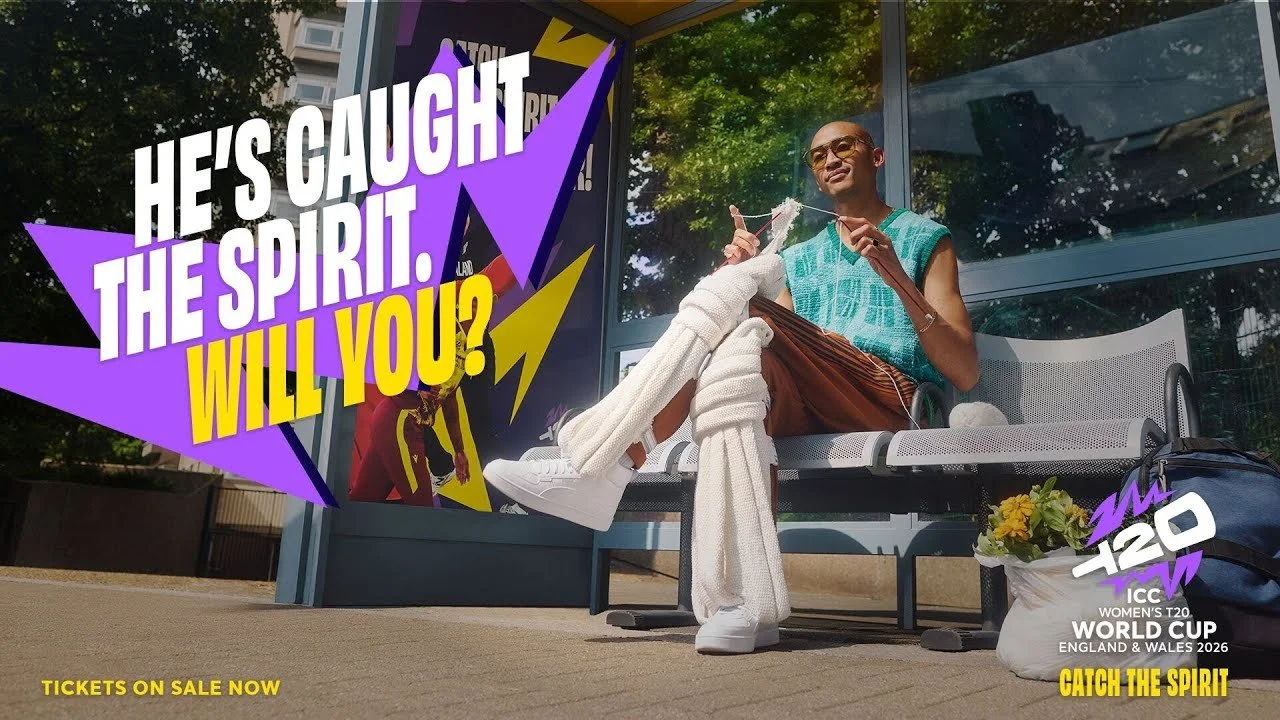
In a bold move the ECB launched the ticket sales for the tournament earlier than they ever have done before to capture the appetite for women’s sport shortly after the Red Roses win at Twickenham with the creative platform and TVC ‘Catch The Spirit’ [creative agency; House337], which perfectly articulates the spirit and vibe cricket will bring to England next summer up and down the country and places the players at the heart of this. It’s an invitation to the nation and the World, calling people in – players, fans, communities. Energy, pride and belonging, it’s about feeling and being part of something unmissable. With over 100k tickets sold, five months before the start of the opening match on 12th June, already outselling the last 50-over World Cup England hosted in 2017, the campaign is already taking hold.
ICC Women’s T20 World Cup - Catch The Spirit AV
The ICC Women’s T20 World Cup 2026 is a once-in-a-generation opportunity to reset what “normal” looks like for women’s cricket. Barrett-Wild beautiful summarises the opportunity as a ‘time to come together and take women’s cricket where it belongs: centre stage. To capture hearts and minds and create passionate fans, not just attendees or casual observers. To embed new norms. New standards. New futures. A future where women’s cricket dominates social feeds, group chats, and daily conversations, becoming as essential to our cultural fabric as our morning scroll.”